 (609) 225-4890 |
 Contact Us
 Sign Up for Email

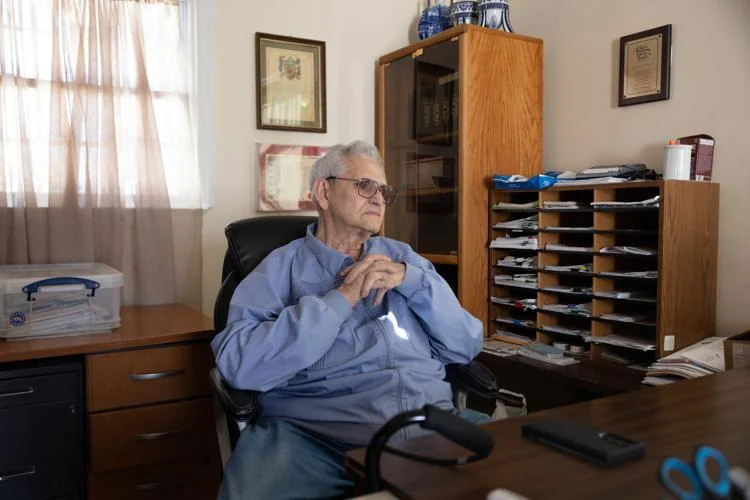
VENTNOR — The $300,000 Angel Eguaras had squirreled away over the decades was supposed to pay for his retirement.
Superstorm Sandy had other ideas.
“We lost the roof of the kitchen and part of the other roof,” he said, recalling the Oct. 29, 2012, storm that caused an estimated $37 billion worth of damage to New Jersey, particularly along the shore. “We had water coming down through the roof.
“And then the water came in through the front door,” said Eguaras, 89.
He and his wife stayed in the waterlogged house at first, until arranging for repairs that were estimated to take three or four months.
It was four and a half years before they could move back in.
“We moved nine times,” Eguaras said. “We went from this house to a rented house for the winter, but when the summer came, the rent went from $1,300 to $4,000, so we went to a hotel. And then back to a house. We did that nine times, back and forth.”
Fourteen years later, Eguaras’ house has been repaired and elevated — twice. But things still need replacing, like a warped door that had to be swapped out last week.
The weekend nor’easter that damaged wide swaths of the Jersey Shore proves the need for a permanent funding source for repairs to eroded beaches, U.S. Rep. Jeff Van Drew said Thursday.
U.S. Sen. Andy Kim, D-N.J., community organizers and victims of Sandy and other storms gathered at Eguaras’ house Thursday on the anniversary of the storm.
The message was twofold: to call for improvements to the nation’s disaster response system, and to spread the word that New Jersey’s main Sandy-era aid program has been restarted for those still struggling to get back home or to fix damaged homes in which they still live.
“We have not fixed this broken system of disaster response in this country,” Kim said. “We need to make sure we’re making the reforms to FEMA, but we also need to make sure FEMA is able to do its job. We’re seeing with the Trump administration a politicization about disaster response, states like New Jersey not getting our fair share because the president and the White House are thinking about states voting for him or not.
“Disaster response should never be partisan, should never be political,” Kim said. “It’s about delivering for Americans in need. We’re seeing the Trump administration in any number of ways try to gut our nation’s response to crisis.”
U.S. Rep. Jeff Van Drew, R-2nd, said there were problems with FEMA during Sandy, while he was still a Democratic state legislator.
“I remember as a state Senator how dysfunctional FEMA was during Superstorm Sandy, Van Drew said. “The remaining problems that we see now are a direct result of that dysfunction.
“During this last nor’easter, we had an immediate response from FEMA and the Army Corp of Engineers,” he said. “We also received the most beach replenishment dollars (99 million) in New Jersey history. The goal to make the disaster process better as well as the goal to increase beach replenishment is not political or partisan. It is a good goal that hopefully will prevent the dysfunction of the past from occurring again.”
The Trump administration’s disaster chief told state officials last week that they must increase their financial reserves and emergency capabilities to handle most disasters on their own, without federal help, Politico reported.
Federal Emergency Management Agency Administrator Cameron Hamilton spoke about the administration’s oft-mentioned plan to shift disaster responsibilities to the states.
“Every state must have the appropriate financial reserves” and other abilities “to ensure that recovery efforts can start immediately and not necessarily be held up simply because of the federal (disaster) declaration process,” Hamilton said, according to a recording of his remarks obtained by Politico. “A future that I hope we would shoot for is one where we wouldn’t require as many disasters because the capability of states is so high and so substantial.”
Amanda Devecka-Rinear, executive director of the New Jersey Organizing Project, said people remain in need.
Gov. Mikie Sherrill said Tuesday it is important to “move as quickly as possible” to repair the damage from last weekend’s nor’easter before the inevitable winter storms hit.
“We would love to be here on the 14th anniversary of Sandy and say, ‘We did it! We fixed the system,’” she said. “But we have (Hurricane) Ida survivors with us, and in some ways, things are worse. We’re here to call attention to the fact that storm survivors are still working to recover.”
Few people are aware that New Jersey has revived the Reconstruction, Rehabilitation, Elevation and Mitigation program it rolled out after Sandy, said Jody Stewart of the organizing project. It is now referred to as RREM-Pathway D.
It provides up to $100,000 in grant assistance to eligible homeowners to rehabilitate remaining Sandy-related damage, or up to $500,000 in funding for eligible reconstruction activities.
Although he received some storm recovery aid from the state, Eguaras said he has spent $300,000 of his own money on repairs.
Approaching his 90th birthday, Eguaras has one piece of advice for others who may be in his position in the future.
“Don’t give up,” said Eguaras, who has cabinets and boxes full of correspondence, bills and receipts related to his post-Sandy experience. “Keep on fighting.
“They’ll tell you one thing today, and tomorrow they’ll change it,” he said. “But I didn’t give up. I stayed with it.”